
THE LEADERS OF TOMORROW
ATHENA & TELEMACHUS ALUMNI
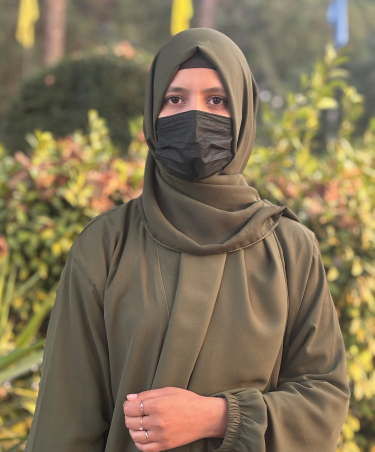
Lubna Sharif:“Education Does Matter.”
LUBNA SHARIF
Lubna is from Pakistan and she is a Visiting Lecturer of English at Government Degree College for Girls. In early 2025, driven by a lifelong commitment to learning, Lubna gained admission to the Master’s programme at Hazara University, Mansehra. She aspires to contribute to education and social development as a researcher and educator, with a particular focus on empowering young women from rural backgrounds. Deeply passionate about literature and critical discourse as tools for social change, she hopes to establish educational initiatives in underserved regions, ensuring access to knowledge for all.
Q: Tell us a few things about you! Your background, your childhood and early beginnings!
My name is Lubna Sharif. I grew up in the green lush valley of district Mansehra. My childhood was great. I had great fun with my family and the neighbourhood children. From swinging in rivers to climbing trees for raw fruits — these are cherished memories. It was full of learning and discovery as well. I was free-spirited and never felt anxious for a moment. As a student, I was mischievous. I was also a favourite. I took part in every game or activity in school.
My academic performance was strong, and I also took part in extracurricular activities. I was quite popular in my school because of my confidence and outspoken personality.
Q: What are some of the key challenges in your society currently?
Climate change is one of the major issues in my country. Pakistan is on the verge of a climate catastrophe. The rain cycle and floods in previous years show how vulnerable the consequences of this problem can be if it remains unresolved.
Secondly, women's empowerment and girls' education are major issues in my society. Every day, we hear news about women being forced into marriage and facing legal constraints without their consent. This shows how pitiable the condition of women is in patriarchal societies.
Q: Share with us some of the hurdles that you had to overcome in your life so far? How did you handle them?
As a woman, the major hurdle I faced was in the area of leadership. In a conservative society, it is often unbelievable to follow a girl's lead and her initiative. People say hundreds of things, point their fingers at you, curse you and a lot more to bring you down, but with my education and confidence, I was able to clear all these hurdles.
Q: Why is the role of a mentor important for you?
The role of a mentor is very essential in one's life, and to me as well. A mentor provides direction to my perspective. Because of deep reflection, my thoughts often lack clarity. By discussing with my mentor, I can arrange them logically. A mentor also opens new gates of knowledge. Discussion and debate lead to the discovery of new points of view. From these discussions, one can learn and apply new expertise to one's own community.
Q: Do you have a lesson that life has taught you and you would like to share?
Education does matter. In today's technology-driven world, education is not given vital importance because of other avenues of development. But I think education is the sole thing that can change a person, a nation and its youth. When you are educated, you know your rights and responsibilities. You become a better person and a better human being.
Q: Name a project, a foundation or a person in your country that you think is doing great work in helping improve other people's lives!
Agha Khan foundation in Pakistan is doing great social work.
Q: What are some of the challenges that women in your country face and what efforts are being made towards gender equality?
Women face a lot of problems; from being financially unstable to being harassed in the workplace are a few common problems. Now, the government and other social activists are putting their energies into fixing these problems.
Q: Share with us a motto you live by.
Carpe diem, Captain!
Q: If you had all the money needed to launch the project of your dreams, can you describe what you would do?
I would open an art school where students can choose what they want to do. They can dance, sing, play chess, make machines and can even explore magic and illusion arts.
Q: How is technology utilised for social impact in your country? For example are there mobile apps that support gender equality, inclusion, understanding of cultures?
Technology can be called the fourth pillar of the state. It is impacting the social life of every individual. It can have both positive and negative effects. On the one hand, it enables us to globalise and see the wonders of the universe. On the other hand, it objectifies women, using their bodies to satisfy the male gaze.